
The Critical First Three Seconds on TikTok
A viewer's decision to stay or scroll on TikTok is made in under three seconds. This tiny window is where the platform's algorithm decides if your content is worth showing to millions. Unlike traditional platforms like YouTube, where creators have the luxury of a gradual introduction, TikTok demands immediate impact. There is no warm up. Your first frame is your only chance to make a first impression.
The TikTok algorithm interprets this initial engagement as a primary signal of content quality. A viewer who hesitates, even for a moment, sends a powerful message that your video is compelling. As highlighted in an analysis by Hook Studio, the first three seconds are not just important, they are the single biggest determinant of whether content will achieve significant reach. A strong hook directly influences metrics that matter, such as completion rate and the highly valued rewatch rate.
That rewatch rate is particularly interesting. It happens when a hook is so dense, intriguing, or visually chaotic that viewers feel compelled to watch it again just to process what they saw. This small action is a massive signal to the algorithm that your content is high quality. A high rewatch rate can dramatically improve TikTok watch time and push your video to a wider audience.
This intense creative pressure to capture attention instantly is not just a challenge, it is the central problem of modern short form video. It is also the precise reason that AI video editing tools have become so essential. They are designed to help creators systematically solve the three second problem, turning a moment of high pressure into a strategic opportunity.
Psychological Triggers of High-Performing Hooks

Now that we understand the stakes of those first few seconds, we can explore what makes a hook work on a human level. Effective hooks are not random, they are rooted in predictable psychological triggers. The most powerful of these is the curiosity gap. This is the mental itch created when a hook poses a question or makes a bold claim that the viewer feels an urge to see resolved. It is the "what happens next" feeling that stops the thumb from scrolling.
Another critical trigger is the pattern interrupt. We all know the hypnotic state of mindlessly scrolling through a feed. A pattern interrupt is designed to jolt a viewer out of that passive consumption. This can be a sudden, chaotic scene, an unexpected sound effect, or a disarmingly vulnerable personal confession. According to a 2026 analysis by Virvid, pattern interrupts are one of the most effective methods for increasing rewatch rates because they break that scrolling trance.
Understanding these principles helps us see how to create TikTok hooks that are consistently effective. We can categorize them into archetypes based on their psychological appeal:
- Chaotic Hooks: These use fast cuts, high energy, and overwhelming visuals to intrigue the viewer. The brain cannot process it all at once, which often triggers a rewatch.
- Personal Hooks: These build an instant connection by addressing the viewer directly or sharing a relatable story. A simple "You need to hear this" can be incredibly effective.
- Suspenseful Hooks: These start mid action or tease a result without revealing it. They create a tension that the viewer needs to see resolved.
These triggers are not just creative theories, they are identifiable patterns in successful content. This is where technology comes in. AI can be trained to recognize these patterns, analyze their effectiveness, and even help generate new ideas based on them. Understanding these psychological triggers is a core part of a successful short-form video strategy, and you can explore more content creation insights on our blog.
Generating Hook Ideas with AI Tools
Using AI as a Creative Partner
The psychological principles behind great hooks provide a strong foundation, but staring at a blank screen is still a common frustration for creators. This is where AI for social media transforms from a concept into a practical tool. AI hook generation platforms act as a creative partner, drawing on massive datasets of viral videos to suggest ideas you might never have considered. They analyze your topic and audience to provide a starting point that is already informed by what works.
Mastering the Art of the AI Prompt
The quality of the ideas you get from an AI tool depends entirely on the quality of your instructions. Vague prompts lead to generic suggestions. The key is specificity. Instead of asking for "video hooks," you need to guide the AI. For example, a much better prompt would be: "Generate 10 suspenseful hooks for a DIY home renovation fail video targeting millennials." This level of detail tells the AI the topic, the tone, and the target audience, resulting in far more relevant and creative outputs. Tools like Flowith and Vmake are specifically designed to act as creative partners, analyzing your topic to generate dozens of potential hooks.
Refining AI's Output
It is important to remember that AI suggestions are a starting point, not a final product. The best creators use AI to overcome creative blocks, not to replace their own voice. The real magic happens when you take the AI generated concepts and infuse them with your unique personality, brand, and context. Modern platforms offer a suite of features designed for this purpose, allowing you to generate ideas and then immediately start editing.
A practical workflow for idea generation looks like this:
- Input your core video topic and target audience into an AI tool.
- Specify the desired hook archetype, such as a question, a bold statement, or a controversial opinion.
- Generate at least 15 to 20 options to ensure you have a wide range of ideas.
- Select the top three to five concepts and manually rewrite them to sound authentic to you.
Refining Hooks with AI-Powered Analytics
Generating great hook ideas is only half the battle. The other half is knowing which ones actually work. In the past, this was a matter of guesswork. Today, it is a data driven science thanks to AI powered analytics. The modern workflow involves A/B testing hooks by filming one core video but creating two or three distinct opening sequences. Preparing these clips for testing is straightforward with tools that let you quickly resize video for different formats or platforms.
After posting the different versions, you can interpret the viewer retention graphs in TikTok’s analytics to see exactly where you are losing your audience. This feedback is no longer a vague feeling, it is a precise diagnostic tool. As noted by Ignission, some creators are now able to identify winning hooks in as little as 60 to 90 minutes by running these quick tests, a cycle time that was previously unimaginable.
Understanding your retention graph is one of the most valuable viral TikTok video tips you can learn. Here is a simple guide to what your graph is telling you in those critical first few seconds.
| Timeframe | Graph Pattern | What It Means | Actionable Step |
|---|---|---|---|
| 0-1 Second | Sharp 20%+ Drop | The visual or audio was an instant turn-off. | Completely rework the opening pattern interrupt. |
| 1-3 Seconds | Steep Decline | The hook failed to create a curiosity gap. | Strengthen the verbal hook or on-screen text promise. |
| 1-3 Seconds | Flat Line | You've successfully held initial interest. | Analyze what keeps them; replicate this element. |
| 1-3 Seconds | Slight Bump Up | The hook is confusing or dense, causing rewatches. | This is a strong signal; double down on this layered style. |
This entire process creates a powerful iterative cycle. You generate ideas with AI, test them in the real world, analyze the data with AI assisted tools, and feed those learnings back into your next batch of content. This transforms content creation from an art based on intuition into a science based on data.
Advanced AI Techniques for Layering Hooks
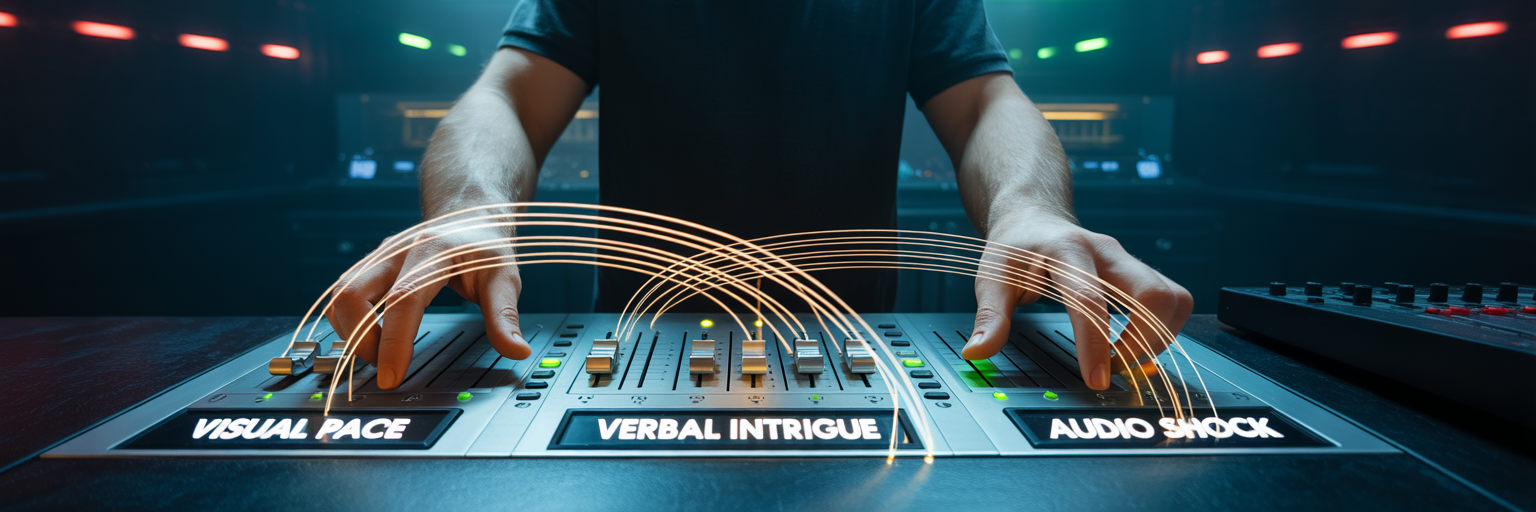
Once you have mastered the basics of hooks and analytics, you can move on to more advanced techniques that set expert creators apart. One of the most effective is hook layering, which is the strategy of combining multiple sensory hooks within the first 1.5 seconds of a video. The goal is not to create confusion but to achieve a "sensory density" that is so rich it encourages an immediate rewatch.
This strategy, known as hook layering, is advocated by platforms like Captain Hook AI, which emphasize that capturing attention across multiple senses simultaneously is key to stopping the scroll in 2026. An effective layered hook combines three distinct elements:
- Visual Hook: This could be an unexpected fast zoom, a shocking reveal of a finished project, or a jarring cut that breaks the visual rhythm.
- Verbal Hook: This is often a provocative question on screen, a voiceover that starts mid sentence, or a bold statement that challenges a common belief. - Audio Hook: This might be a trending sound used in an ironic way, a sudden and dramatic sound effect like a record scratch, or a powerful musical sting that punctuates the visual.
Executing this complex technique effectively is where AI video editing tools become indispensable. An AI can suggest trending audio that perfectly matches the pace of your video. It can also recommend the optimal timing for on screen text to appear for maximum impact and even analyze the visual composition of your opening frame. Layering hooks manually is tedious and time consuming, but with AI, it becomes a streamlined part of your creative process.
Proven Hook Formulas for AI Implementation
To bring all these concepts together, here is a practical toolkit of repeatable formulas that you can implement with the help of AI. These formulas provide a reliable foundation for your short-form video strategy, giving you a clear playbook for creating engaging content.
- Start with the Result: Show the finished cake, the stunning "after" of a renovation, or the final punchline of a joke. The psychology here is simple, you are immediately satisfying the viewer's desire for a payoff while creating curiosity about the process. AI helps by automatically scanning a long video to identify the most visually impactful frame to place at the beginning.
- The Direct Address: Speak directly to a niche audience. A hook like, "If you're a coffee shop owner in Austin..." creates an instant, personal connection. AI hook generators excel at this, crafting hyper specific, localized questions that an individual creator might not think of on their own.
- The "You're Doing It Wrong" Hook: Challenge a common belief within your niche. This contrarian approach positions you as an expert and makes viewers stop to question their own methods. AI can analyze top performing content in a category to identify these common beliefs, providing the perfect setup for a hook that goes against the grain.
- The Mid-Action Opening: Start your video in the middle of a chaotic or high stakes moment. This drops the viewer directly into the action and forces them to keep watching to understand the context. AI editing tools can analyze a clip for peak motion or audio cues and automatically trim it to start at that exact point of maximum impact.
With these formulas in hand, the right platform can help you bring them to life. Blitzreels provides the AI-powered tools needed to generate, edit, and analyze your hooks, turning strategy into viral content.